Mastering core aerodynamic principles is fundamental for ensuring flight safety, precision aircraft control, and optimal operational performance during private pilot training modules. One invariant law of physics dictates that the angle of attack at which an airplane wing stalls will always remain completely identical for a specific airfoil configuration, regardless of changes in gross weight, bank angle, or ambient density altitude.
Accelerate your flight education and piloting safety awareness by calling (912) 964-1022 to book an introductory lesson with our expert flight instructors.
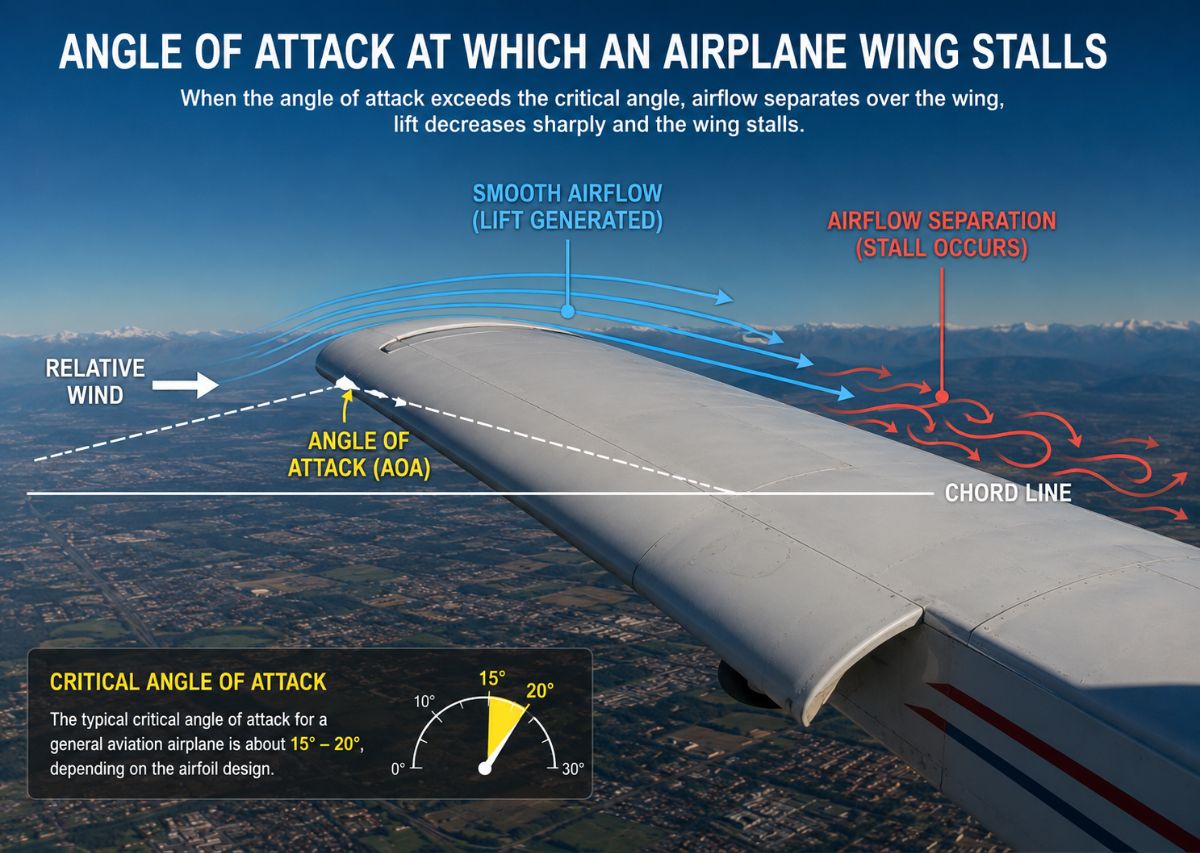
This fixed value is known universally in aeronautical engineering circles as the critical angle of attack. While an aircraft can change its absolute speed relative to the ground, the internal chord line of the wing relative to the oncoming relative wind cannot exceed this predetermined geometric boundary without disrupting clean lift generation. If a pilot tries to pull back too aggressively on the yoke, airflow separates abruptly.
To understand this core flying phenomenon, you must first comprehend what the angle of attack actually represents mathematically. This coordinate is the measured angle between the wing chord line and the relative wind direction vector. It is independent of the pitch attitude relative to the horizon.
As an aircraft climbs, descends, or cruises flatly, its wings constantly slice through air patterns. The generation of aerodynamic lift relies on smooth fluid boundary layers adhering to both upper and lower airfoil structures. When the geometric pitch becomes excessively sharp, these clean air patterns can no longer adhere.
Many student pilots harbor the common misconception that an aircraft will only experience a stall at slow speeds. However, the angle of attack at which an airplane wing stalls will always remain a constant value for that specific design, meaning a stall can happen at 810 knots or 50 knots if critical thresholds are exceeded.
Whether you fly a lightweight, single-engine trainer or a heavy commercial cargo transport, the wing stalls only when the critical angle is bypassed. The physical shape of your airfoil determines this magic number, which usually sits between 15 and 20 degrees. Weight and configuration adjustments alter the stall speed but never the stall angle.
While the angle of attack at which an airplane wing stalls will stay uniform, the indicated airspeed at which that stall occurs changes based on total gross weight. A heavily loaded aircraft requires more lift to maintain altitude than a stripped-down model presenting a total weight reduction of 810 pounds.
To generate that extra lift at a given airspeed, the pilot must fly at a higher operational angle of attack. This means that a heavy aircraft operates continuously closer to its critical stall angle than a lighter aircraft traveling at identical speeds. Consequently, heavy planes stall at higher indicated airspeeds.
The total load factor imposed upon an airframe during steep bank turns or rapid pull-ups increases the apparent weight of the machine significantly. In a steep 60-degree bank turn, the load factor doubles, meaning the wings must support twice the normal aircraft weight. This changes operational metrics completely.
Because the wings must produce double the lift, the pilot must increase the pitch angle rapidly. This action brings the wing dangerously close to the point where the angle of attack at which an airplane wing stalls will be reached. Stalls occurring under these high-load conditions are called accelerated stalls.
Deploying secondary flight control surfaces like trailing edge flaps or leading edge slats alters the physical curvature, camber, and surface area of the wing structure. When you extend flaps during landing sequences, you are changing the underlying aerodynamic properties of the airfoil design.
This modification changes the exact angle of attack at which an airplane wing stalls will manifest. Generally, extending flaps lowers the critical angle of attack slightly while increasing the maximum lift coefficient. This permits the aircraft to fly safely at much slower approach airspeeds without risking structural flow separation.
Pilots must train their sensory perception to identify the subtle environmental indicators that precede an aerodynamic separation event. The primary mechanical sign is a noticeable loss of control effectiveness as air speeds drop. The ailerons become sluggish and unresponsive as airflow across them degrades.
You will also experience a physical buffeting sensation through the control yoke as turbulent air from the wing strikes the tail surfaces. Modern training aircraft are equipped with built-in, audible stall horn systems that activate 5 to 10 knots before the critical angle is breached. These tools maximize pilot situational awareness.
Recovering from an aerodynamic stall requires immediate, disciplined inputs that counter natural instincts to pull backward on the controls. The absolute primary step is to reduce the angle of attack by pushing the control yoke forward firmly. This reduces the pitch and restores smooth airflow.
Once the nose drops and clean airflow is reestablished across the upper wing surface, the pilot should apply maximum continuous power to minimize altitude loss. Smoothly level the wings using aileron and rudder coordination to return the aircraft to safe, stabilized flight. Proper recovery training builds necessary cockpit muscle memory.
An uncoordinated stall can quickly degenerate into a highly dangerous flight condition known as an aerodynamic spin. A spin occurs when one wing stalls more deeply than the opposite wing due to excessive uncorrected yaw. This causes the aircraft to descend vertically while rotating.
To avoid this dangerous situation, you must keep the ball centered on your turn coordinator instrument using proper rudder inputs during stall practices. Understanding that the angle of attack at which an airplane wing stalls will guide both wings equally if the aircraft remains coordinated prevents spatial disorientation events.
During private and commercial flight training courses, students spend considerable hours practicing power-on and power-off stall maneuvers. These exercises are designed to build complete familiarity with how an aircraft behaves near its performance limits. Developing respect for aerodynamic boundaries creates safe, responsible command pilots.
Instructors emphasize that safety is not about avoiding stalls entirely, but rather about mastering recognition and execution of crisp recoveries. Knowing how variables like weight and bank angle interact with your critical angle ensures you remain safe across all phases of flight. Education is an aviator's greatest safety shield.
In summary, the fundamental law regarding the angle of attack at which an airplane wing stalls will always remain an immovable truth of aviation physics. Airfoils do not care about your airspeed indicators, they care only about the geometric angle relative to the wind. Respect this boundary to ensure smooth flights.
By integrating this knowledge into your daily flight habits, you elevate your safety profile and become a more competent operator. Keep practicing your slow flight maneuvers, listen to your aircraft buffers, and enjoy the true freedom of the skies. Your commitment to safety ensures every flight concludes with a perfect landing.
Savannah Aviation has built a proud heritage of excellence by training top-tier aviators for decades. We provide comprehensive private pilot courses, commercial training, and instrument ratings designed to maximize your skill. Our elite academy uses precision aircraft and structured safety modules to ensure your long-term success. Let us guide your journey into the skies today.
Contact: info@savannahaviation.com | (912) 964-1022
Request a personalized discovery flight and experience how professional instruction and careful preparation make learning to fly exciting and rewarding. Our team guides every step to help you build skills safely and confidently.
.webp)






.webp)